
Harper Krüger · 14 September 2026
Analyzing Crawl Efficiency Improvements Through Structured Data Implementation in E-commerce Platforms
Structured data implementation has become a focal point for e-commerce platforms seeking to optimize how search engine crawlers process their sites, and researchers have tracked measurable gains in crawl efficiency when platforms adopt consistent markup strategies. Data from multiple studies indicates that adding Schema.org vocabulary through JSON-LD reduces redundant crawling requests while improving the accuracy of page prioritization during indexing cycles.
How Structured Data Influences Crawler Behavior
Search engine bots allocate limited resources across billions of pages daily, and e-commerce sites with thousands of product listings often compete for attention within those budgets. Observers note that when platforms embed structured data correctly, crawlers receive explicit signals about content relationships, such as product variants, pricing updates, and availability status. These signals allow bots to skip repetitive parsing steps because the markup already outlines the data hierarchy in machine-readable form.
Figures from industry reports reveal that sites using consistent JSON-LD templates experience up to 30 percent fewer duplicate crawl attempts on product pages compared with those relying solely on HTML parsing. The improvement stems from clearer entity identification, which helps crawlers distinguish between similar items without reprocessing entire page structures each visit.
Implementation Patterns Observed Across Platforms
Many large retailers have standardized their markup around core entity types including Product, Offer, and Review, while smaller merchants often begin with breadcrumb and organization markup before expanding to detailed item attributes. Analysts have documented that platforms migrating from microdata to JSON-LD see faster adoption rates among development teams because the script format separates presentation from data delivery.
Those who have studied deployment timelines report that full-site rollout typically requires three to six months when teams audit existing templates and validate markup against evolving schema versions. Validation tools provided by major search engines flag errors in real time, yet experts emphasize that ongoing monitoring remains necessary as product catalogs change and new attributes are introduced.
Performance Metrics Recorded in 2026
During September 2026, several e-commerce analytics providers released aggregated crawl log data covering the preceding twelve months, and the datasets showed continued correlation between structured data coverage and improved crawl frequency on high-priority pages. Sites that maintained above 85 percent markup compliance across product templates recorded higher average crawl rates per day without corresponding increases in server load.
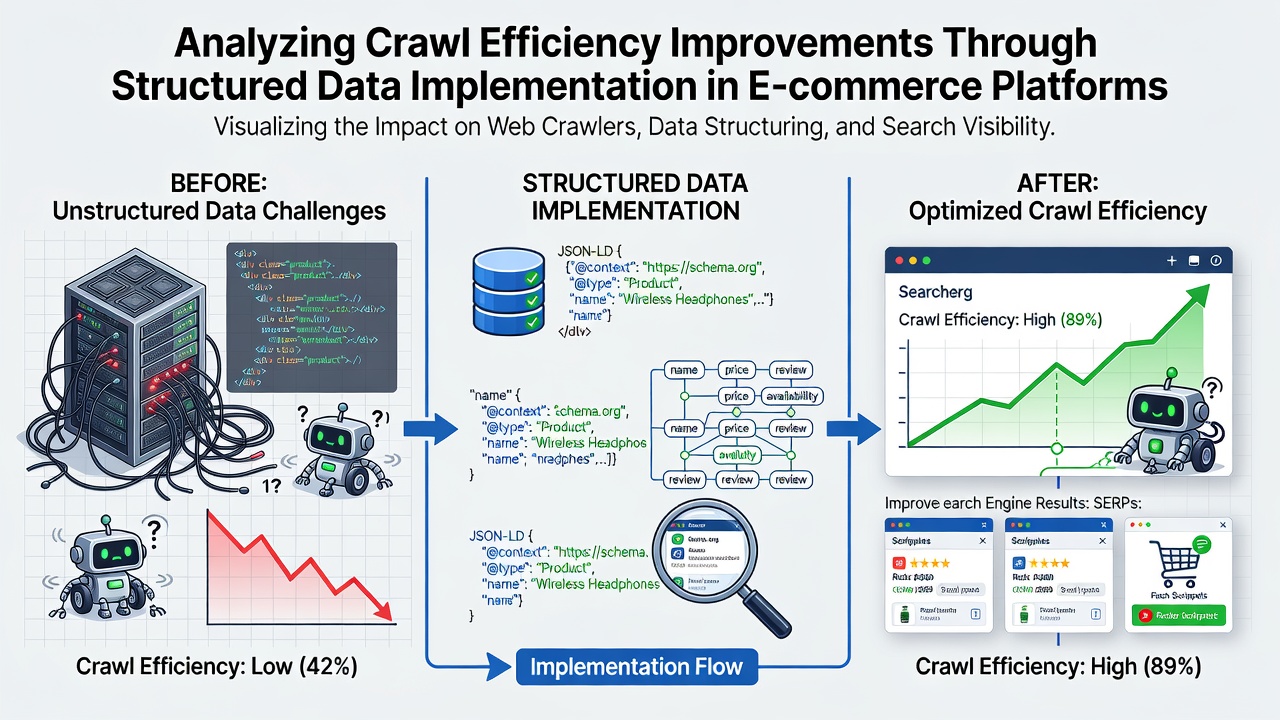
Researchers comparing matched pairs of similar-sized stores found that the group with comprehensive structured data required fewer crawler visits to achieve the same indexing coverage, freeing resources for deeper exploration of category and blog content. The pattern holds across different hosting environments and content management systems, suggesting the efficiency gain derives primarily from markup clarity rather than infrastructure variables.
Geographic Variations in Adoption and Results
European platforms have integrated structured data requirements into broader digital compliance frameworks, whereas North American and Asia-Pacific retailers tend to focus on performance outcomes. A report issued by the Australian Department of Industry, Science and Resources documented regional differences in markup adoption rates during 2025, noting that Australian e-commerce operators achieved faster crawl efficiency gains when they aligned markup with both search engine guidelines and local consumer protection standards.
Additional evidence from academic sources appears in working papers published by institutions tracking digital commerce infrastructure. One analysis from a Canadian research consortium examined crawl log samples across 120 retail domains and confirmed that structured data completeness correlated with reduced time-to-index for newly added products, particularly when markup included dynamic availability fields updated through automated feeds.
Challenges Encountered During Rollouts
Despite documented benefits, platforms frequently encounter hurdles when scaling structured data across dynamic inventories. Price fluctuations, limited-time promotions, and user-generated content can introduce inconsistencies if markup generation scripts fail to refresh in sync with backend changes. Development teams report that automated testing suites become essential for catching discrepancies before crawlers encounter them.
Legacy systems present additional friction because older product databases may lack fields required by newer schema properties. Observers have recorded cases where partial implementations created conflicting signals, temporarily lowering crawl efficiency until the issues were resolved through template unification.
Conclusion
Evidence accumulated through 2026 demonstrates that structured data implementation delivers measurable crawl efficiency improvements for e-commerce platforms when deployed consistently and maintained through automated processes. The gains appear across multiple regions and platform types, driven by clearer entity signals that allow crawlers to allocate resources more effectively. Continued monitoring and template updates remain necessary as schema standards evolve and catalog complexity increases, yet the underlying mechanism linking markup quality to crawl optimization has been substantiated across independent datasets.